
A Real World Facility Safety Self-Check
Jan 9th 2026
Why these scenarios matter (FY2025 OSHA Top 10)
Every year, OSHA shares a “Top 10” list of the standards most frequently cited during inspections. For fiscal year 2025 (Oct 1, 2024 – Sept 30, 2025), OSHA released preliminary results at the National Safety Council Safety Congress & Expo. The big headline: Fall Protection (1926.501) stayed #1 for the 15th straight year, and many of the other items are the same recurring themes we see in the field: hazard communication, ladders, energy control, forklifts, PPE, and machine guarding.
How this works
You’ll see 10 short workplace scenarios. For each one, choose the option you believe best matches what an inspector would likely think if they observed the situation during a walkthrough.
Note: This is practical guidance meant to build safer habits. Always follow your site’s written program and hazard assessment.
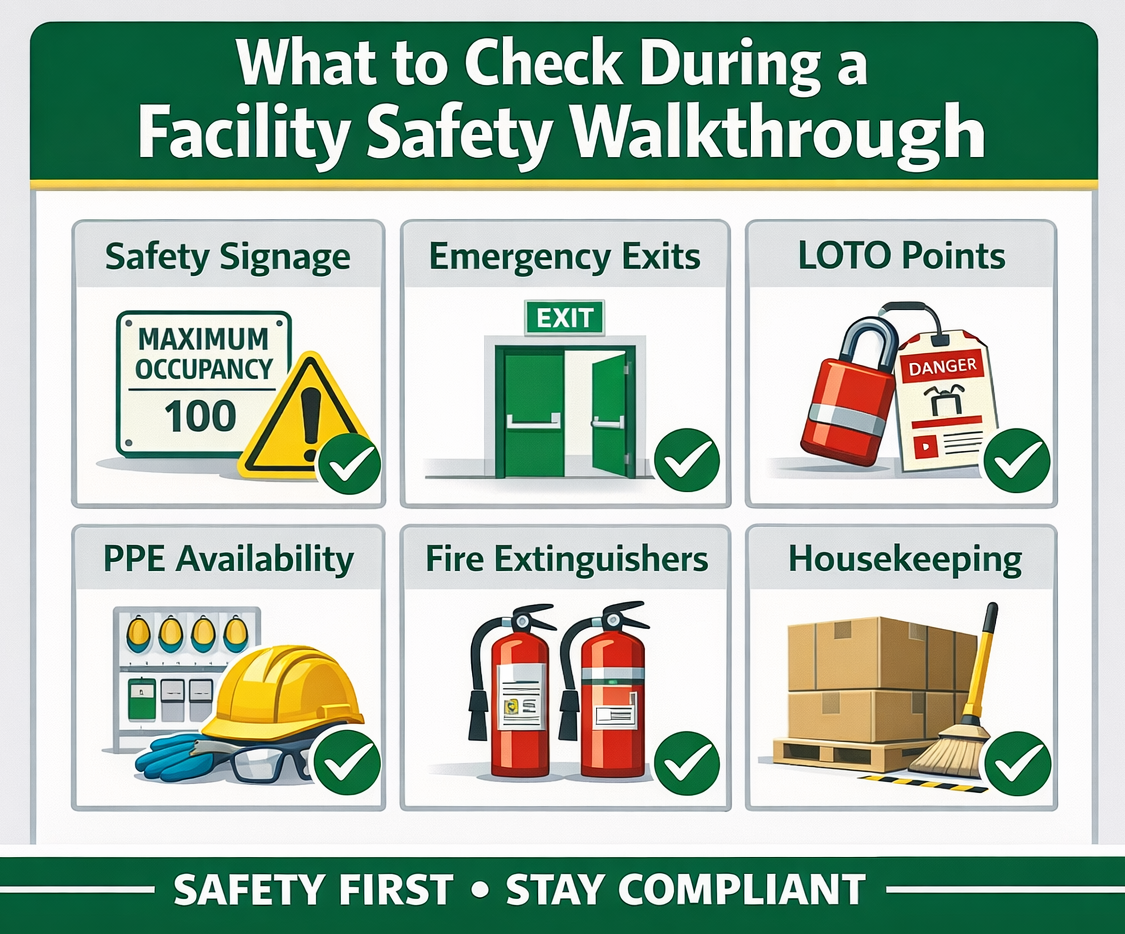
Quick visual reference for a facility safety walkthrough.
Scenarios
In an area where eye protection is required, an employee is adjusting a part at a drill press. Their safety glasses are on top of their head for “just a second,” then they plan to pull them down before drilling.
Forklifts operate in a warehouse. Pedestrian aisles are painted and signed, but there are no physical barriers. Some employees wear hi-vis, others don’t because “I’m staying in the aisle.”
A marked hard-hat area includes overhead crane travel paths and storage racks. A worker removes their hard hat while walking between stations because nothing appears to be moving overhead at the moment.

A routine facility walkthrough focuses on everyday conditions, not staged inspections.
An employee is using a grinder with a face shield down and safety glasses underneath. Another employee insists the glasses are unnecessary because “the face shield covers your face.”
A guard was removed to clear a jam and the machine is still powered. The operator says they’ll “put it back in a minute” and only reached in briefly.
A facility built a pedestrian-only corridor using physical barriers and self-closing gates. Forklifts cannot enter the corridor, and intersections have controlled access. Workers in the corridor are not wearing hi-vis vests.
A pallet of boxed product is staged in a marked exit access aisle. It’s still passable, and the supervisor says it’s only there until the next truck arrives later today.
Safety glasses are required in the area. An employee’s lenses are heavily scratched and slightly cloudy. They keep using them because “they’re still glasses” and replacements are kept in a cabinet across the building.
An employee uses compressed air to blow dust off their shirt and arms at the end of a task. They aim the nozzle away from their face and say it’s “faster than brushing off.”
A pedestrian aisle is marked, but a worker regularly steps into the forklift aisle for a few seconds to pass a slow-moving cart. Forklifts are active and the worker assumes drivers will “see me.”