New SDS, Now What? Your Guide to the November HazCom Deadline
An updated safety data sheet lands in your inbox. It’s for a chemical your team has used for years. Same product. Same job. Another document to file away?
Before you click “save” and move on, give it a closer look. That familiar chemical may come with newly identified hazards—and your workplace labels, procedures, or training may need to catch up.
With OSHA’s November 20, 2026, HazCom employer deadline approaching, now is a good time to give your hazard communication program a checkup.
The good news? You don’t automatically need to replace every label or gather the entire company for another training session. The task is to review updated information, understand what has changed, and make the updates your workplace actually needs.
Let’s walk through it.
The Essentials at a Glance
November 20, 2026, is the employer deadline for substances. Make necessary updates to alternative workplace labels, your written HazCom program, and employee training to address newly identified hazards.
A revised SDS doesn’t always mean more work. An updated phone number and a newly identified health hazard call for very different responses.
Start with what’s on your shelves. Compare your chemical inventory with the products employees actually use, then review the relevant SDSs.
Mixtures have a different deadline. Employers have until May 19, 2028, to make corresponding updates for mixtures. Existing HazCom responsibilities continue in the meantime.
What Does the November 20 Deadline Mean for Employers?
OSHA updated its Hazard Communication Standard in 2024 to better align with the Globally Harmonized System, or GHS, and improve how chemical hazards are classified and communicated.
Those changes involve both the companies supplying chemicals and the workplaces using them.
For substances, manufacturers, importers, and distributors had until May 19, 2026, to comply with the revised requirements. Employers then have until November 20, 2026, to make necessary workplace updates based on newly identified hazards.
Under 29 CFR 1910.1200(j)(2)(ii), those updates may include:
Alternative workplace labeling
The written hazard communication program
Additional employee training
The phrase “as necessary” matters here. This deadline doesn’t automatically send every label to the recycling bin. Review the new hazard information and determine what needs to change.
Mixtures follow a later schedule: November 19, 2027, for suppliers and May 19, 2028, for necessary employer updates.
A substance is an individual chemical element or compound; a mixture combines two or more substances. If you’re unsure how a product is classified, check its SDS or ask the supplier.
Start with a Chemical Inventory Reality Check
Your chemical inventory is the starting point. First, make sure it matches what’s actually in the building.
That means looking beyond the usual storage cabinet. Check production areas, maintenance shops, and other departments where chemicals are used. A product tucked onto a maintenance shelf still belongs in the review.
Purchasing and receiving can help, too. They may have updated supplier documents that haven’t made their way to your environmental, health, and safety team. Maintenance may also have products purchased outside the usual ordering process.
Bring those pieces together before diving into the SDS review. It’s much easier to check the paperwork when you know which products you’re checking.
Give Updated SDSs a Closer Look
Start with Section 16, which lists the preparation or last revision date. Then compare the updated SDS with the version already on file.
Pay particular attention to:
Section 2 — Hazard Identification: Are there newly identified physical or health hazards?
Section 8 — Exposure Controls and Personal Protection: Have recommended protective measures or PPE changed?
Section 7 — Handling and Storage: Are there new precautions for using or storing the chemical?
Section 10 — Stability and Reactivity: Are there new incompatible materials, conditions to avoid, or hazardous reactions to consider?
Sections 4–6 — First Aid, Firefighting, and Accidental Release Measures: Have the emergency instructions changed?
A newer revision date alone doesn’t tell you whether workplace changes are needed. Some revisions are administrative.
If the update identifies a new hazard, follow that information into the workplace. Where is the chemical used? Who handles it? Do existing labels, procedures, and training already cover the hazard?
Those answers will help you build a useful update list.
Follow the Information from the Label to the Training
Once you identify a newly communicated hazard, check the places employees rely on for guidance: container labels, written procedures, and training.
Workplace Labels That Keep Up
Under OSHA’s workplace labeling requirements, employers may use the applicable shipped-container label information or an alternative system that communicates the required hazard information.
Picture a maintenance team that transfers a single-substance solvent into smaller containers for routine jobs. The supplier issues an updated SDS identifying an additional hazard.
That’s the cue to compare the new information with the workplace labels already in use. If the alternative labels no longer communicate the hazards appropriately, update them.
And remember: the portable-container exception is limited to immediate use. The chemical must stay under the control of the employee who transferred it, be used only by that employee, and be used within the same work shift.
“I’ll probably use it tomorrow” doesn’t meet that definition.
A Written Program That Matches the Workplace
Your written HazCom program explains how your facility handles chemical labels, SDSs, and employee information and training.
Give it a read with current operations in mind. Does it still describe what happens on the floor?
Newly identified hazards may call for changes to labeling procedures or how employees learn about hazards during non-routine tasks. The program should also accurately explain how employees can access chemical safety information.
If you discover hazardous chemicals missing from the inventory, add them. A newly identified hazard for a chemical already listed, however, doesn’t automatically mean you need a duplicate entry.
The goal is a program people can use—and one that reflects how your facility operates today.
Training That Answers Employees’ Real Questions
Next, consider whether affected employees need additional training.
Under 1910.1200(h), employers must provide effective training when a chemical hazard employees haven’t previously been trained about is introduced into their work area.
Keep any additional training focused on what employees need to know:
How could exposure happen, and how can they recognize it?
Which protective measures and work practices apply?
What should they do in an emergency?
Where can they find the relevant hazard information, and how do they use it?
A general GHS refresher can be useful, but it shouldn’t take the place of explaining a newly identified hazard that affects someone’s daily work.
Make the connection concrete: “Here’s what changed, here’s where you may encounter it, and here’s what you need to do.”
Keeping a record of who received the training and what it covered is also a helpful management practice.
Your HazCom Action Checklist
You don’t need to keep the entire review in your head. Use this checklist to move from “we should look at that” to completed updates.
Check your chemical inventory. Confirm that it reflects the hazardous chemicals actually used throughout the facility.
Track down SDSs. Contact suppliers about missing documents or whether revised versions are available.
Compare the information. Look for newly identified hazards and changes to recommended precautions.
Decide what needs updating. Review alternative workplace labels, written procedures, and employee training.
Assign the work. Give each necessary update a clear owner.
Record completion. Note what changed, who completed it, and when.
Starting early gives your team time to follow up with suppliers and make thoughtful updates before the deadline arrives.
Make Chemical Safety Information Easy to Find
Your review may uncover a few practical housekeeping opportunities along the way.
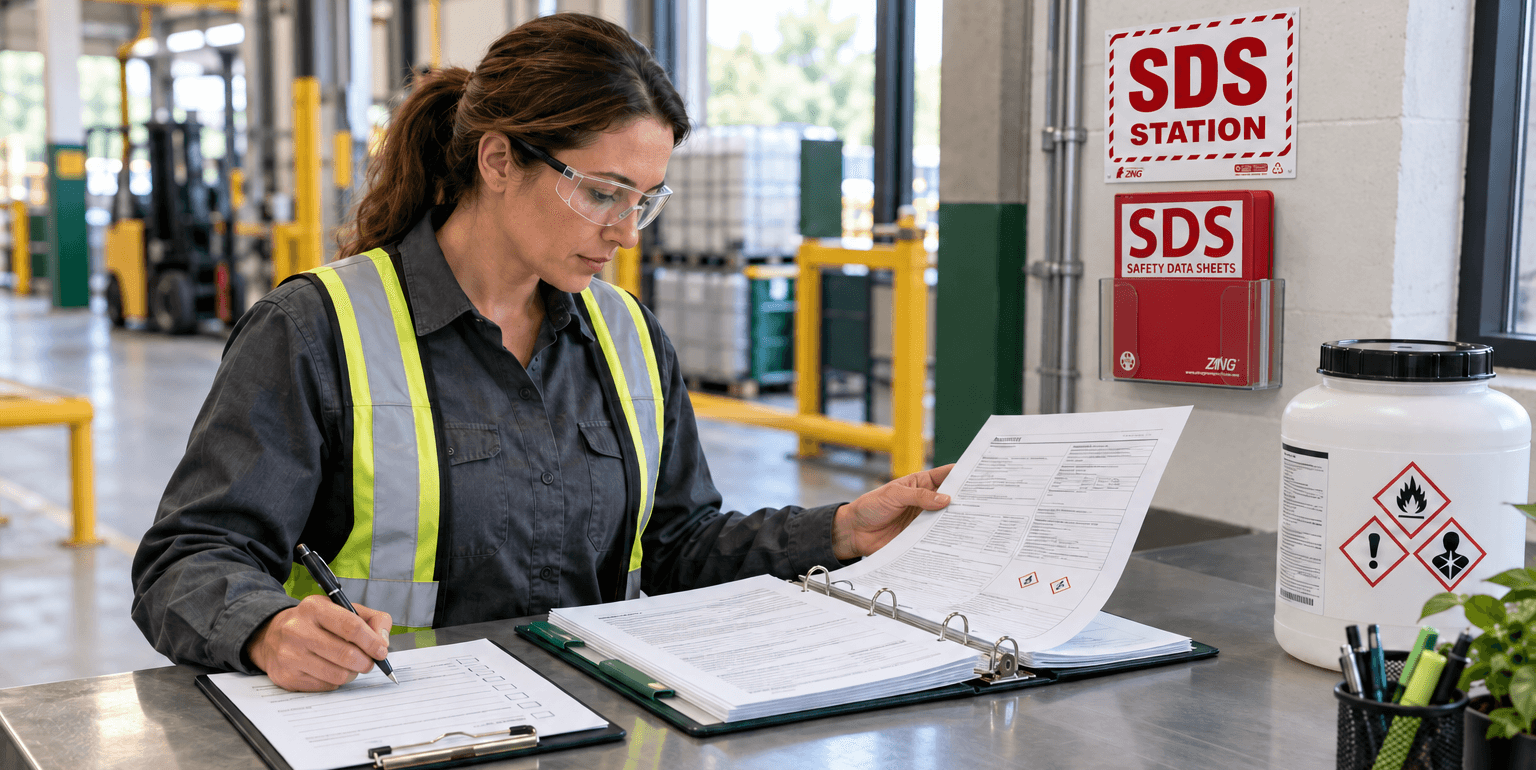
Can employees quickly find the SDS they need? Are hazard labels readable? Is the SDS station somewhere people can readily access it?
Clear labels and organized information help employees put your HazCom program into practice.
ZING offers products that support those everyday communication needs:
Hazard Signs and Labels
Help employees identify chemical hazards with signs and labeling products suited to the workplace application. ZING’s collection includes options made from recycled materials.
SDS Binders
The ZING 6034 Eco GHS-SDS Binder holds up to 500 sheets and features English/Spanish labeling. Made from recycled plastic, it provides a durable home for printed chemical safety information.
SDS Stations
The ZING 2708 Eco SDS Economy Station Kit includes a wall-mounted holder, SDS binder, and station sign, helping you establish a designated place for chemical safety information.
These products support the communication work behind your HazCom program by helping keep information visible, organized, and accessible.