Lockout Tagout Kits: What You Need to Include
Lockout/tagout kits help safety teams, maintenance departments, and authorized employees keep essential energy control devices organized and ready for use. But a good LOTO kit is not a one-size-fits-all box of supplies. It should be built around the equipment, energy sources, and isolation points found in your facility.
The right kit can help employees quickly access the devices they need to lock out electrical, mechanical, pneumatic, or fluid energy sources before servicing or maintaining equipment. However, the kit itself is only one part of a complete energy control program. Written procedures, employee training, proper application, and verification of isolation are also essential.
Use this lockout tagout kit checklist as a starting point when reviewing your facility’s equipment, energy sources, and common maintenance tasks.
Before selecting a lockout/tagout kit, start with one key question:
What energy sources and isolation points do our employees actually need to control?
What Is a Lockout Tagout Kit?
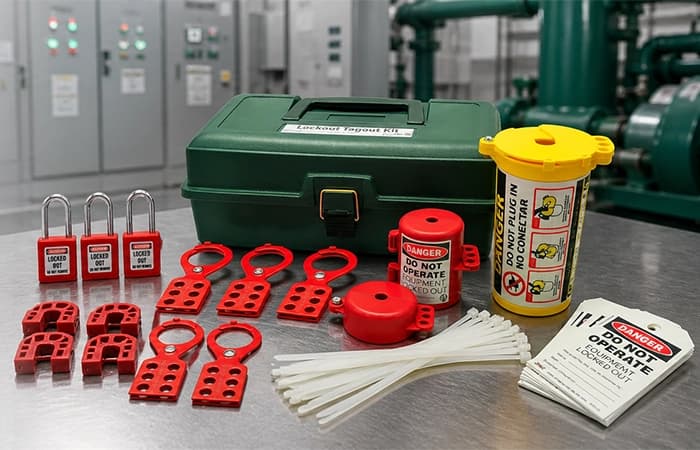
A lockout/tagout kit is a collection of devices used to help secure equipment during service, repair, cleaning, adjustment, inspection, or maintenance. Kits may be assigned to individual authorized employees, stored in maintenance areas, or placed near specific machines or departments.
A typical kit may include padlocks, tags, hasps, breaker lockouts, valve lockouts, plug lockouts, cable lockouts, pneumatic lockouts, and other devices used to help prevent unexpected startup or the release of hazardous energy.
These kits are commonly used by maintenance teams, machine operators, electricians, facility managers, safety managers, and authorized employees responsible for servicing or maintaining equipment.
A well-stocked kit saves time, improves consistency, and helps ensure employees have access to the right device when equipment needs to be isolated.
Do Not Build a Kit Around Guesswork
One common mistake is purchasing a general lockout/tagout kit and assuming it covers the entire facility. Starter kits can be helpful, but they may not include every device style or size needed for your specific equipment.
Before selecting or updating a kit, review your facility for:
Electrical disconnects and breaker types
Plug-connected equipment
Gate valves, ball valves, and other valve types
Pneumatic connections
Hydraulic, mechanical, thermal, or chemical energy sources
Equipment with multiple energy sources
Group lockout applications
Outdoor or harsh-use environments
Missing, damaged, or frequently borrowed lockout devices
This review can help determine whether your team needs a compact personal kit, a department-level kit, a wall-mounted station, or a more specialized set of lockout devices.
Core Items to Include in a Lockout Tagout Kit
A basic lockout/tagout kit may include:
Lockout padlocks
Lockout tags
Lockout hasps
Circuit breaker lockouts
Electrical plug lockouts
Gate valve lockouts
Ball valve lockouts
Cable lockout devices
Pneumatic lockouts
Push-button lockouts
Switch lockouts
Tag fasteners or ties
Marker or tag pen
Carrying case, pouch, or storage box
Larger facilities may need more than one kit. For example, an electrical maintenance kit may focus on breaker lockouts, plug lockouts, padlocks, tags, and hasps. A mechanical maintenance kit may require valve lockouts, cable lockouts, pneumatic devices, and additional group lockout supplies.
Device Selection Guide
The most useful lockout/tagout kits are built around real equipment needs. Each device should match the energy source and isolation point it is intended to control.
Use the guide below to help identify common lockout/tagout devices and where they are typically used.
Circuit Breaker Lockouts
Used for: Electrical energy
Isolation point: Panel breaker handle
Best for: Locking out branch circuits or equipment feeders at the source.
Circuit breaker lockouts help secure breaker handles in the OFF position during service or maintenance work.
Kit note: Include multiple breaker lockout styles if your facility has different panel or breaker types.
Gate Valve Lockouts
Used for: Mechanical or fluid energy
Isolation point: Gate valve handwheel
Best for: Helping prevent rotation of rising-stem or non-rising-stem valves.
Gate valve lockouts cover the valve handwheel to help keep the valve from being turned.
Kit note: Gate valves come in different sizes, so make sure your kit includes lockouts that match the valves used throughout your facility.
Ball Valve Lockouts
Used for: Mechanical or fluid energy
Isolation point: Quarter-turn valve handle
Best for: Holding lever-style valves in the OFF position.
Ball valve lockouts help secure quarter-turn valve handles used to control fluid, air, or gas flow.
Kit note: Facilities with different handle sizes may need more than one ball valve lockout style.
Plug Lockouts
Used for: Electrical energy
Isolation point: Cord and plug
Best for: Enclosing and locking power plugs to help prevent reconnection.
Plug lockouts are used for cord-connected equipment, portable tools, machines, and other devices that can be isolated by controlling the plug.
Kit note: Check plug size before selecting a device. Some facilities may need lockouts for both standard and oversized plugs.
Pneumatic Lockouts
Used for: Compressed air
Isolation point: Air hose coupler
Best for: Helping block or disconnect air supply to tools, cylinders, or equipment.
Pneumatic lockouts are used where compressed air powers machinery, production tools, cylinders, or moving components.
Kit note: Include pneumatic lockouts in areas where equipment relies on air pressure, even if electrical lockout is also required.
Cable Lockouts
Used for: Mixed or multiple energy sources
Isolation point: Multiple points or oversized hardware
Best for: Capturing several isolation points or irregular shapes with one device.
Cable lockouts are flexible devices used when standard lockout devices do not fit or when several points need to be secured together.
Kit note: Cable lockouts are useful backup devices because they can adapt to unusual lockout points.
Push-Button Lockouts
Used for: Electrical or mechanical controls
Isolation point: Push button or selector switch
Best for: Helping prevent accidental activation of start, stop, or selector buttons.
Push-button lockouts are commonly used on control panels, machine interfaces, and equipment with exposed controls.
Kit note: Review control panels and machine interfaces to determine whether push-button or selector switch lockouts are needed.
Switch Lockouts
Used for: Electrical energy
Isolation point: Toggle or wall switch
Best for: Locking standard wall or panel switches in the OFF position.
Switch lockouts help secure toggle-style switches that could re-energize equipment or create an unsafe condition during service work.
Kit note: These devices are simple, but they can be important in areas where equipment or systems are controlled by a wall or panel switch.
Lockout Hasps
Used for: Group lockout applications
Isolation point: Device hasp hole or lock point
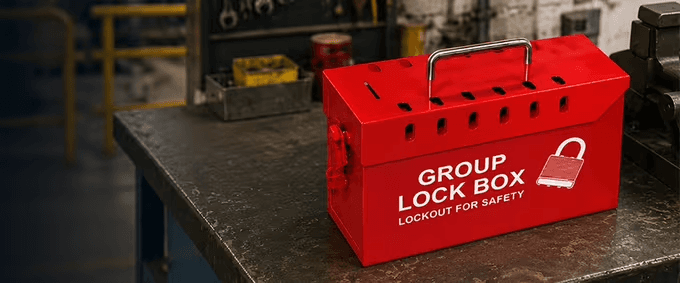
Best for: Allowing multiple workers to apply individual padlocks during group lockout.
Lockout hasps are used when more than one authorized employee is involved in service or maintenance.
Kit note: Keep extra hasps available in shared kits, maintenance areas, and lockout stations.
Padlocks and Tags
Used for: All energy sources, when used with the appropriate lockout device
Isolation point: Lockout point or attachment point
Best for: Providing personal control and identification, including name, reason, and date/time.
Padlocks and tags are core components of most lockout/tagout kits. Padlocks provide physical control, while tags communicate important information about the lockout.
Tags should be durable, easy to read, and securely attached. They are an important communication tool, but they should not be treated as a substitute for a lockout device when equipment is capable of being locked out.
Kit note: Stock enough padlocks and tags for individual employees, group lockout situations, and replacement needs.
Personal Kits vs. Area Kits
Different teams may need different LOTO setups.
Personal lockout kits are often assigned to authorized employees who regularly perform service or maintenance work. These kits usually include personal padlocks, tags, hasps, and common lockout devices needed for routine tasks.
Area lockout kits are stored near specific departments, production lines, maintenance areas, or equipment zones. These kits can include spare sizes and specialty devices matched to the equipment in that area.
Lockout stations are a good option when multiple employees need shared access to locks, tags, hasps, and lockout devices. Stations help keep supplies visible, organized, and easier to audit.
What a Lockout Tagout Kit Does Not Replace
A lockout/tagout kit helps organize the devices employees may need, but it does not replace a complete energy control program.
Kits should be selected and stocked to support your facility’s established procedures. They do not replace:
Written energy control procedures
Employee training
Equipment-specific lockout steps
Proper shutdown and isolation
Control of stored or residual energy
Verification that hazardous energy has been isolated
Periodic review of procedures and practices
In other words, a kit supports the process. It does not become the process.
When to Review or Update Your Lockout Tagout Kit
Lockout/tagout kits should be reviewed regularly, especially when equipment, processes, or work areas change.
You may need to update a kit when:
New machinery is installed
Existing equipment is modified
Maintenance procedures change
A new energy source is introduced
Lockout devices are missing, damaged, or worn
Employees report that the correct device is not available
Group lockout needs increase
A safety audit identifies gaps
A simple kit review can help prevent delays and reduce the chance that employees are left searching for the right device when equipment needs to be isolated.
Final Tip: Match the Kit to the Procedure
The best lockout/tagout kit is one that supports your written energy control procedures. Map each machine or asset to the devices required to isolate its energy sources, then stock kits and stations based on those real-world needs.
Keep spare sizes on hand for commonly used devices such as breaker lockouts, valve lockouts, plug lockouts, cable lockouts, hasps, padlocks, and tags.
A well-planned lockout/tagout kit does more than organize supplies. It helps support safer work, clearer communication, and more consistent energy control practices across the facility.
Shop Lockout Tagout Kits and Devices
Explore ZING Green lockout/tagout kits and devices to build a setup that matches your facility’s equipment, energy sources, and maintenance needs.
ZING Green Safety Products offers lockout/tagout kits, padlocks, tags, hasps, breaker lockouts, valve lockouts, plug lockouts, cable lockouts, pneumatic lockouts, push-button lockouts, switch lockouts, stations, and group lockout solutions to help support your facility’s energy control program.