Understanding Ear Safety
This guide will walk you through how hearing works, when noise becomes unsafe, and how to select and train for effective hearing protection.
Exposure to dangerous noise levels is one of the most common workplace hazards. According to OSHA, more than 22 million workers are exposed to hazardous noise every year. That exposure drives an estimated $242 million in workers’ compensation costs and over $1.5 million in annual fines for employers. The good news is that there are simple, cost-effective, and easy-to-implement solutions that help you protect your team and stay compliant.
How the Ear Works
The ear is divided into three main sections: the outer ear, middle ear, and inner ear. Sound waves enter the outer ear, travel through the ear canal, and vibrate the eardrum and tiny bones in the middle ear. These vibrations are then passed into the inner ear.
Inside the inner ear is the cochlea, a small, fluid-filled structure lined with microscopic hair cells called cilia. When sound waves reach the cochlea, they cause the cilia to move. This movement converts sound waves into nerve impulses that travel to the brain, where they are interpreted as sound. Loud noise can permanently damage these delicate hair cells, leading to irreversible hearing loss.
When Does Noise Become Unsafe?
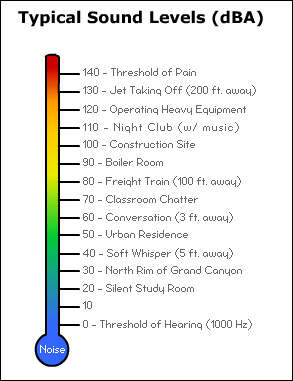
Noise exposure at or above 85 decibels (dBA) can begin to damage hearing over time. Many common industrial tools and processes easily exceed this level, including sanding, drilling, cutting, grinding, and spray-painting operations. The National Institute for Occupational Safety and Health (NIOSH) provides noise level examples to illustrate how frequently workers encounter hazardous noise:
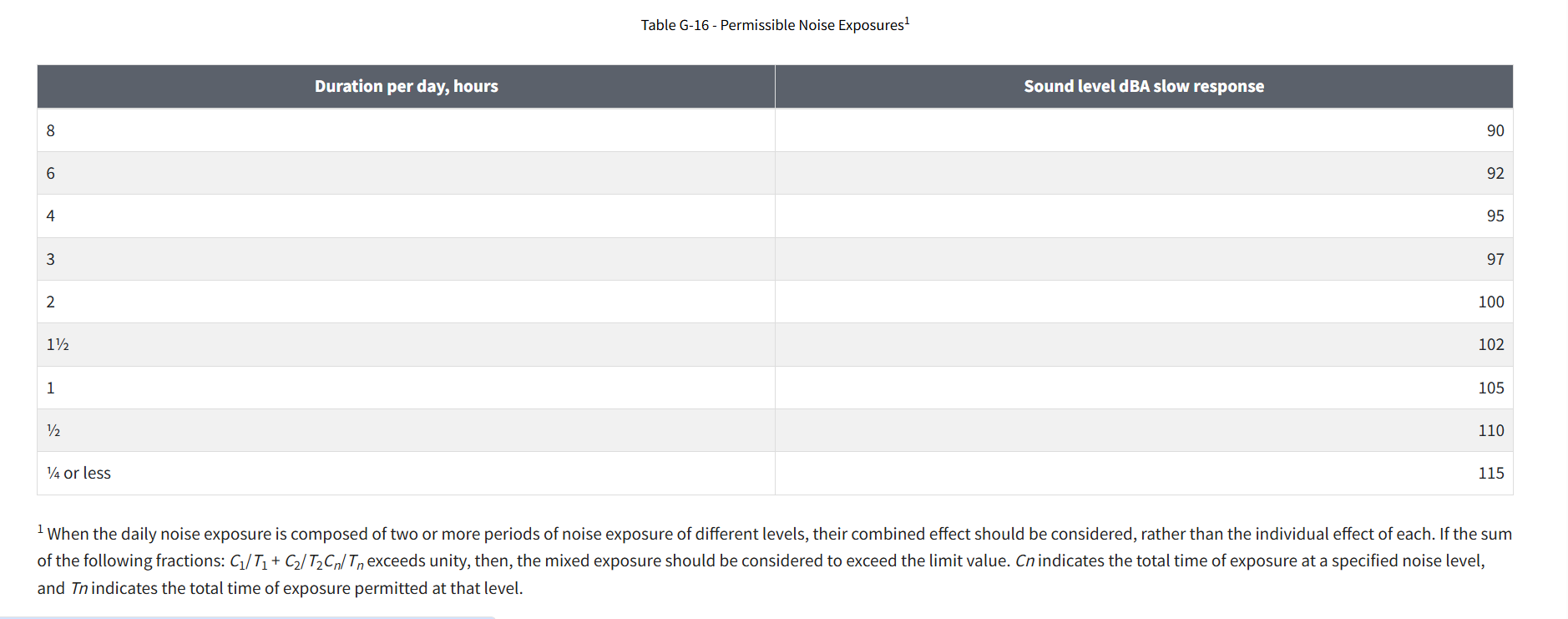
 The risk of hearing damage is a combination of noise level and duration. As noise levels increase, the amount of safe exposure time drops significantly. This table from OSHA shows permissible levels of noise exposure by time and decibels:
How Do I Keep My Workplace Safe?
What precautions can I take?
Engineering controls, such as enclosing noisy equipment, installing sound-absorbing materials, or redesigning processes are the preferred first step to reduce noise at the source. However, in many facilities, hazardous noise cannot be fully eliminated. In those cases, a strong hearing conservation program and the right hearing protection devices (HPDs) are essential.
The two most common types of hearing protection are ear plugs and ear muffs. Both can be safe, comfortable, and cost-effective when correctly selected and used:
Ear plugs are inserted into the ear canal and typically offer higher levels of protection than muffs when properly fitted.
Ear muffs fully cover the outer ear and are less dependent on technique to achieve an effective seal.
All hearing protection is assigned a Noise Reduction Rating (NRR), which indicates the level of sound reduction the device can provide under laboratory conditions. In the field, actual protection depends heavily on fit and consistent wear. OSHA provides guidance on estimating real-world protection in standard 29 CFR 1910.95, Appendix B, and recommends applying a 50% correction factor to account for real-world conditions.
Ear muffs offer some advantages over plugs: they tend to have less variation in performance because they are not inserted into the ear canal, and they can also shield ears from cold weather or wind. However, muffs alone generally provide less protection than properly fitted plugs and are best for moderate noise or for use together with ear plugs. Wearing muffs over plugs can add roughly 5 dB of additional protection to the overall NRR.
How Do I Train My Employees?
Your program will not be effective without proper training.
Employees exposed to an 8-hour time-weighted average of 85 dBA or higher must be included in a hearing conservation program and provided with appropriate hearing protectors. Protection is only effective when devices are worn correctly and consistently, so hands-on training and supervision are critical.
Comfort is a key driver of compliance. Uncomfortable or poorly fitting ear plugs are more likely to be removed or loosened during the shift, which can expose workers to damaging noise levels. OSHA requires employers to offer a selection of hearing protection devices and to supervise initial fitting to ensure proper use. At a minimum, one type of ear plug and one type of ear muff must be available, but OSHA recommends multiple options. For many facilities, offering at least three different ear plug styles or sizes helps accommodate most workers.
Hearing protectors also have a limited service life. Foam ear plugs and the cushions or seals on reusable plugs and muffs can harden, crack, or lose elasticity over time, reducing their protective performance. Employers must replace hearing protectors as needed at no cost to the employee. Some reusable plugs can be cleaned with mild soap and water, but dirty or damaged plugs can increase the risk of ear infections and other health issues. Because of this, many employers choose single-use disposable ear plugs to help ensure hygiene and consistent performance.
By pairing smart noise control strategies with the right mix of ear plugs, ear muffs, and training, you can significantly reduce the risk of hearing loss in your facility.
By combining knowledge of the facility, suitable PPE, and proper training, you can keep your workers safe from potential ear damage.